Aurora
Northern Lights in 2026-27: Has the Solar Maximum Passed?
Where Solar Cycle 25 stands in autumn 2026, according to NASA, NOAA and other official sources, what the declining phase means for the aurora, and why cloud and darkness decide more of your nights in Rovaniemi than the Sun does.
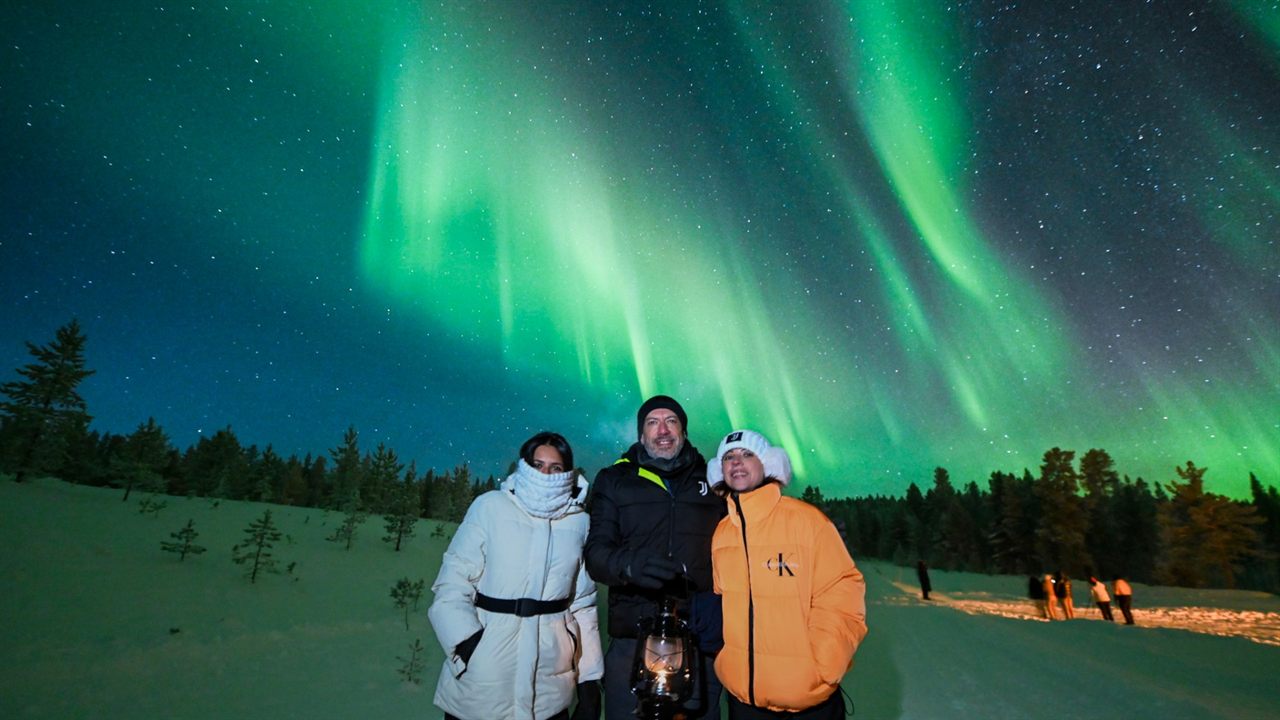
Short answer: yes. The Sun passed the peak of Solar Cycle 25 in late 2024 and sunspot numbers are falling, but strong geomagnetic storms still happen in this declining phase, and Rovaniemi needs only modest activity, about Kp 2-3 under a clear sky. In winter 2026-27, cloud and darkness will decide your nights far more than the solar cycle.
If you have read that the solar maximum is over, you may wonder whether you have missed the best years. This guide sets out what NASA, NOAA and other official sources say now, and why the cycle matters less in Lapland than further south.
What is the solar cycle?
The solar cycle is the rise and fall of the Sun's activity over about 11 years, measured by counting sunspots.
Sunspots are often where solar flares and coronal mass ejections (CMEs) start, and NOAA links the largest geomagnetic storms to CMEs. Solar maximum is the part of the cycle with the most sunspots, solar minimum the part with the fewest. The current cycle is Solar Cycle 25. Its peak can only be dated afterwards: NASA and NOAA explained in October 2024 that the month of the peak would be identified months or years later, once activity had clearly dropped.
Where does Solar Cycle 25 stand now?
Past its peak: the smoothed sunspot number peaked in October 2024 and has fallen since, although the Sun is still far from quiet.
- NASA and NOAA, 15 October 2024: the Sun had reached its solar maximum period, which could continue for the next year before the declining phase begins.
- Royal Observatory of Belgium (SIDC): SIDC, the source of the sunspot numbers NOAA uses, puts the maximum of the smoothed monthly sunspot number at 160.9 in October 2024, above the 115 predicted by the international panel in 2019. It says activity has been gradually declining since.
- NOAA's Space Weather Prediction Center (SWPC): its solar cycle progression page, checked in October 2026, plots the observed sunspot numbers against an updated prediction that replaced the 2019 panel forecast (a maximum of 115 in July 2025) on the site in February 2025. The page does not name a peak month. It expects Solar Cycle 26 to begin between January 2029 and December 2032.
| Month | Monthly sunspot number | Smoothed sunspot number |
|---|---|---|
| August 2024 | 216, the highest month of the cycle | 156.8 |
| October 2024 | 165.8 | 160.9, the peak |
| October 2025 | 114.8 | 108.5 |
| March 2026 | 86.6 | 94.4, the latest smoothed value |
| September 2026 | 60.3 (preliminary) | Not yet available |
Figures from NOAA SWPC's observed solar cycle data. Monthly numbers jump around; the smoothed number shows the trend, and NOAA treats the most recent 6 months as preliminary. NOAA's updated prediction has the sunspot number at about 86-89 through winter 2026-27, falling to about 35 by December 2028.
Does a declining cycle mean fewer auroras?
It means fewer sunspots, but not far fewer auroras in Lapland: storms continue in the declining phase, and in Lapland auroras are common even at solar minimum.
- NASA notes that storms are less frequent in the declining phase, but that scientists often see fairly significant storms during it. NOAA adds that high-speed solar wind streams, usually weaker than CMEs, can feed energy into Earth's magnetic field over a longer time.
- SIDC reports severe geomagnetic storms in November 2025 and January 2026, with aurora seen over Belgium in both. It says the Ap index, a measure of how disturbed Earth's magnetic field is, is rising to a new high for this cycle even as sunspots decline, and its latest progress report expects further episodes of very enhanced solar and geomagnetic activity over the next two years.
- The Finnish Meteorological Institute (FMI) writes that the number of large auroral displays follows sunspot numbers with a lag of a couple of years, that this effect is strongest in southern Finland, and that in Lapland auroras are quite common even during solar minimum.
- NOAA SWPC says coronal holes, a source of fast solar wind, are more common and persistent in the years around solar minimum. Their high-speed streams can cause minor to moderate geomagnetic storms (G1-G2, which NOAA's scale sets at Kp 5-6), and a long-lived hole can last several 27-day solar rotations, so an active night can return about 27 days later.
What the decline mainly reduces is the number of very large storms that push the aurora far south. In Lapland those storms are a bonus, not a requirement.
Why does Rovaniemi need only modest activity?
Because Rovaniemi lies close to the auroral oval, the ring around the magnetic pole where auroras occur, it needs only Kp 2-3 under a clear sky, not a storm.
NOAA SWPC's rule of thumb puts the southern edge of the auroral oval near 66° magnetic latitude at Kp 0, moving about 2° towards the equator for each step of Kp. Rovaniemi, at 66.5° N, lies at only about 63° geomagnetic latitude, so the oval reaches it at around Kp 1-2. For comparison, NOAA says it takes a G2 storm (Kp 6) for aurora to be seen as far south as about 55° geomagnetic latitude.
FMI places Finland on the southern rim of the auroral oval. On a dark, cloudless night it puts the chance of auroras at roughly 50% at the Lapland ski resorts such as Levi and Ylläs and roughly 25% around Oulu and Kuusamo; Rovaniemi lies between. Our live aurora forecast for Rovaniemi shows tonight's Kp, solar wind and Bz, with a table of what the readings mean here.
Why does cloud matter more than the cycle?
In Rovaniemi a clear sky decides more nights than the Sun does: a Kp of 2 under a clear sky beats a Kp of 5 under stratus.
The aurora forms 80-500 km above the ground, far above the weather, so cloud hides it whatever the cycle does. November to January bring the most cloud, which is why our average chase distance rises from about 40 km in September and March to about 120 km in December and January. Every evening our guides compare three cloud-cover models with the live solar wind and Kp, then drive to the clearest sky: often 100 km or more on the group tour, up to 350 km on the small-group tour, and into Sweden when needed.
Planning to try alone? Read whether you can see the Northern Lights in Rovaniemi without a tour and the best places to see the Northern Lights near Rovaniemi.
The equinox effect: why are September and March strongest?
Geomagnetic activity rises around the spring and autumn equinoxes, so September and March are the strongest aurora months in any year of the cycle.
NOAA SWPC names the weeks around the spring and autumn equinoxes as the best seasons for aurora watching. FMI notes that auroras are slightly more frequent in spring and autumn than in winter and summer, and names March and early April as the best time in northern Finland. The most widely cited explanation is the Russell-McPherron effect, published in 1973: around the equinoxes, the tilt of Earth's axis and magnetic field relative to the Sun gives the solar wind's magnetic field a larger effective southward component (negative Bz), the direction that lets energy in.
September 2026 has passed, so the next equinox window is March 2027. NOAA notes that the hours of darkness shrink quickly around the spring equinox, so expect shorter nights. Read the Northern Lights in Rovaniemi in March and the best month to see the Northern Lights in Rovaniemi.
What should you do about it?
Plan at least three nights, book a hunt for the first one and keep the others free for a second try.
- Stay three nights or more. Cloud decides most nights, so every extra night is another chance.
- Book the first night. If it is cloudy, you still have time for another hunt. Our three aurora tours are free to cancel up to 24 hours before.
- Check the forecast each evening. Look at cloud first, then Kp, Bz and solar wind speed.
- Pick dark dates if you can. A full moon makes faint aurora look fainter; the week around a new moon gives the deepest contrast.
- Dress for standing still. Winter clothing is not provided on our Northern Lights tours. Follow our packing list for a Northern Lights night, or rent a set from 39€ for 1 day up to 129€ for 10 days.
Our group tour costs 59€ per person, the small-group tour 149€ per adult and the private tour 1800€ per group of 1-8. All three run from late August to mid-April: compare our three Northern Lights tours.
Whichever tour you pick, every Polar Lapland aurora hunt comes with the 100% money-back Aurora Guarantee: no photo of you with the Northern Lights, full refund.
Sources: NASA, NASA, NOAA: Sun reaches maximum phase in 11-year solar cycle (15 October 2024); NOAA Space Weather Prediction Center, Solar cycle progression and its observed solar cycle data, predicted solar cycle data, Geomagnetic storms, Coronal holes, NOAA space weather scales and Tips on viewing the aurora; Royal Observatory of Belgium (SIDC), Solar Cycle 25 reached its maximum in October 2024 and Progress of SC25; Finnish Meteorological Institute, Auroras in Finland; C. T. Russell and R. L. McPherron, Semiannual variation of geomagnetic activity, Journal of Geophysical Research, 1973; Polar Lapland guides and tour pages. All checked October 2026.
Frequently Asked Questions
Has the solar maximum passed?
Yes. The smoothed sunspot number of Solar Cycle 25 peaked in October 2024, according to the Royal Observatory of Belgium, and NASA and NOAA said that month that the maximum period could continue for about a year. Sunspot numbers have fallen since, but strong geomagnetic storms still occur.
Is 2026-27 a good winter for the Northern Lights in Lapland?
Yes. Rovaniemi needs only about Kp 2-3 under a clear sky, the Finnish Meteorological Institute says auroras in Lapland are common even at solar minimum, and severe storms have continued since the peak. Cloud and darkness will matter more than the solar cycle.
Will there be fewer Northern Lights in 2027 and 2028?
Sunspot numbers are predicted to keep falling towards the next minimum, and NOAA expects Solar Cycle 26 to begin between January 2029 and December 2032. The cycle matters less in Lapland: the Finnish Meteorological Institute says its effect is strongest in southern Finland, that large displays lag sunspots by a couple of years, and that auroras in Lapland stay common even at solar minimum.
What Kp index do you need to see the Northern Lights in Rovaniemi?
Usually Kp 2-3 under a clear, dark sky. Rovaniemi lies at about 63° geomagnetic latitude, where NOAA's rule of thumb puts the edge of the auroral oval at around Kp 1-2. A geomagnetic storm, Kp 5 or more, is a bonus, not a requirement.
When is the best time to see the Northern Lights in 2026-27?
March 2027 has the best odds, with the equinox effect and clearer skies; the Finnish Meteorological Institute names March and early April as the best time in northern Finland. Any month from late August to mid-April can work. December and January have the most darkness but more cloud.
How many nights do you need to see the Northern Lights?
Plan at least three. Cloud is the main obstacle, so each extra night is another chance. Book an aurora hunt for your first night, so a cloudy evening still leaves time for another try.